Topograph
Live portfolio dashboard synced from Carta and AngelList for valuations, MOIC, ownership percentages, and dilution history across multiple funds.
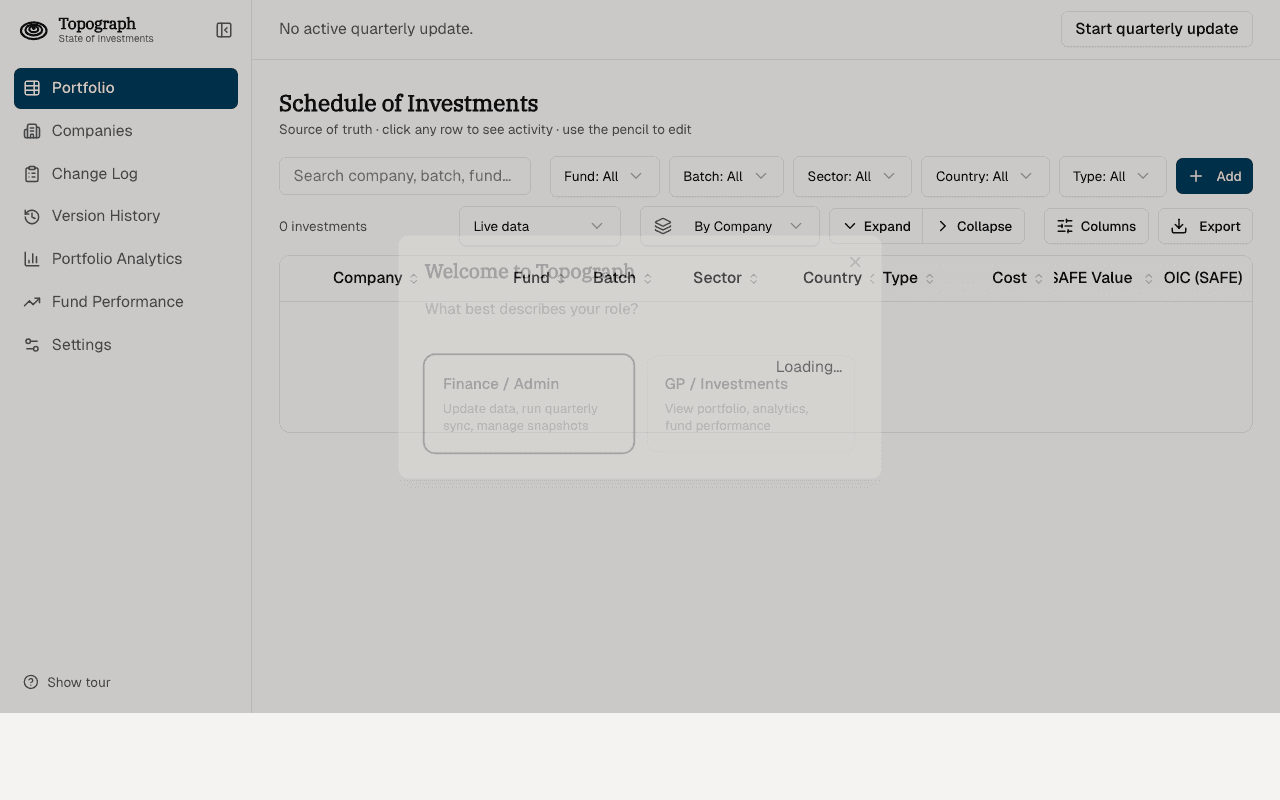 Topograph portfolio view
Why I built this
Ownership data across a VC portfolio is split between Carta (cap tables) and AngelList (deal records). Answering "what's our current ownership in company X after their Series B?" meant pulling multiple Carta reports and cross-referencing spreadsheets. I wanted a single dashboard that modelled ownership through every financing event across all funds.
What it does
Topograph pulls live cap table data from Carta and AngelList, models ownership through each financing event, and computes current stakes and follow-on exposure across the full portfolio. A unified dashboard surfaces ownership percentages, cost basis, MOIC, and dilution history, all in one place.
Data integration
Carta API
Carta provides cap table data per company: share classes, outstanding shares, option pools, and conversion terms. Topograph pulls:
- Stakeholder positions: fund's shares by class, with vesting schedules and conversion rights
- Financing rounds: pre/post-money valuation, new shares issued, price per share
- Cap table snapshots: fully-diluted ownership at each round close
The API returns data per fund entity, so Topograph aggregates across Fund 1, 2, and 3 to compute total exposure per company.
AngelList API
AngelList provides deal-level data that Carta doesn't: investment amount, deal terms (pro-rata rights, liquidation preferences), and syndicate co-investors. This fills in the financial picture that Carta's equity-focused view misses.
Reconciliation
Carta and AngelList don't always agree because of rounding differences, timing mismatches on round closes, and occasional data entry errors. Topograph runs a reconciliation step that flags discrepancies above a configurable threshold (default: 0.5% ownership difference) for manual review.
Equity modelling
Dilution waterfall
For each company, Topograph models the ownership waterfall:
- Start with initial investment position (shares + cost basis)
- Apply each subsequent financing round: new shares issued, dilution to existing holders
- Factor in option pool expansions and convertible note conversions
- Compute current fully-diluted ownership percentage
The model handles standard and weighted-average anti-dilution provisions, pay-to-play clauses, and participation rights on liquidation preferences.
Portfolio metrics
| Metric | Computation |
|---|---|
| MOIC | Current fair value ÷ total invested capital |
| IRR | Time-weighted return using investment dates and current valuation |
| Ownership % | Fully-diluted shares held ÷ total fully-diluted shares |
| Unrealised gain | (Current valuation × ownership %) - cost basis |
| Follow-on exposure | Pro-rata allocation needed to maintain ownership in next round |
All metrics are computed per-company and aggregated per-fund, with a portfolio-wide roll-up.
Quarterly snapshots
Topograph stores quarterly snapshots of all metrics, enabling trend analysis: MOIC over time, ownership drift, and valuation multiples. The snapshot diff view highlights which companies moved the most quarter-over-quarter, which is useful for LP reporting and internal reviews.
Technical decisions
- Quarterly sync over real-time: cap table data changes at most a few times per year (financing rounds, option grants). A quarterly sync with manual trigger for round closes is sufficient. Real-time would add complexity for no practical benefit.
- Computed columns over pre-aggregated tables: ownership percentages and MOIC are computed on read, not stored. This means the dashboard always reflects the latest data model without migration headaches when the calculation logic changes.
- Server-side rendering for financial data: all portfolio data stays server-side. The client never receives raw ownership numbers or valuations, only the rendered dashboard. This is a security requirement for LP-sensitive data.
Stack
Next.js 15, Carta API, AngelList API, Supabase PostgreSQL, Tailwind CSS, Vercel
Lead Engineer at ShiftControl, building an AI-native IT operations platform on Google Workspace. Previously the sole engineer at Iterative (early-stage VC fund, SEA & South Asia). Based in Ho Chi Minh City, Southeast Asia.