Fathom
AI-powered founder scoring pipeline that aggregates public signals and evaluates applicants against a structured rubric, triaging the top of the funnel at scale.
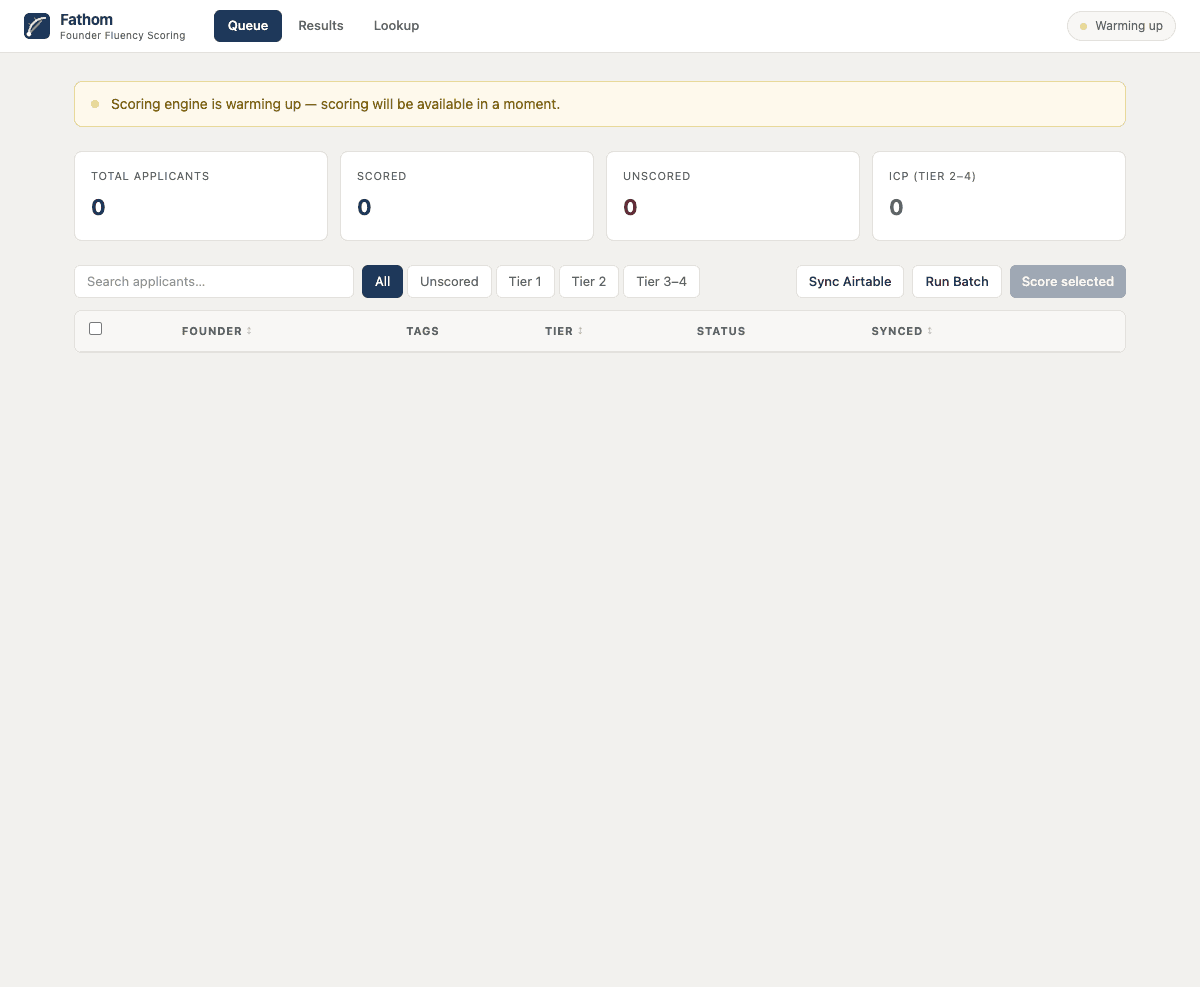 Fathom scoring queue
Why I built this
Evaluating founder quality at scale is subjective and slow. Signal is buried across pitch decks, LinkedIn profiles, news coverage, and reference calls, and different team members weight factors differently. The top of the funnel was bottlenecked by how many applications the team could manually review. I wanted a consistent, automated first pass that surfaced high-potential founders earlier.
What it does
Fathom pulls applicants from Airtable into a managed queue, aggregates publicly available signals (LinkedIn, Crunchbase, news, pitch materials), and scores each founder against a structured rubric using an LLM evaluation pipeline. Scores are calibrated across four dimensions: founder-market fit, technical depth, prior execution, and domain insight.
Scoring pipeline
Data aggregation
For each founder, Fathom collects:
- LinkedIn (via Proxycurl): work history, education, skills, connection count, activity level
- Crunchbase: prior companies founded, funding history, exits
- News/web (via Tavily): press coverage, speaking engagements, published writing
- Application data (via Airtable): pitch deck, company description, traction metrics, sector
All sources are fetched concurrently and merged into a structured founder profile document.
Evaluation rubric
The rubric has four dimensions, each scored 1-5:
| Dimension | What it evaluates | Signal sources |
|---|---|---|
| Founder-market fit | Does their background uniquely position them for this market? | LinkedIn career trajectory, domain publications |
| Technical depth | Can they build the product themselves or evaluate those who do? | Work history, GitHub (if available), technical content |
| Prior execution | Have they built and shipped before? At what scale? | Crunchbase history, prior company outcomes |
| Domain insight | Do they have a non-obvious thesis about their market? | Application pitch, news coverage, published writing |
Tiered evaluation
Not every application gets the same depth of analysis:
- Tier 1, Quick filter (GPT-4o-mini, ~$0.003/applicant): reads the application summary and assigns a pass/review/reject signal. ~60% of applications are clearly outside thesis and get filtered here.
- Tier 2, Full evaluation (GPT-4o, ~$0.05/applicant): the remaining 40% get the full rubric evaluation with all aggregated data. Each dimension gets a score and 2-3 sentences of reasoning.
- Tier 3, Deep dive (manual trigger): for borderline cases, runs additional research (competitor analysis, market sizing) and produces a detailed assessment. Used for ~5% of applicants.
This tiered approach keeps total pipeline cost under $50/batch for ~500 applicants.
Calibration
Raw LLM scores drift over time and across prompt versions. Fathom calibrates by:
- Anchor examples: 20 pre-scored founders (5 per dimension score level) are included in every evaluation prompt as few-shot examples
- Score distribution monitoring: if the mean score drifts beyond 0.5 from the historical mean, an alert fires and the prompt is reviewed
- Human override loop: partners can adjust any score with a reason. Overrides feed back into the anchor set for the next calibration cycle.
Structured output
Every score is generated as structured output with a Zod schema:
z.object({
  founderMarketFit: z.object({
    score: z.number().min(1).max(5),
    reasoning: z.string().min(50).max(500),
  }),
  technicalDepth: z.object({ ... }),
  priorExecution: z.object({ ... }),
  domainInsight: z.object({ ... }),
  overall: z.object({
    recommendation: z.enum(['strong_yes', 'yes', 'maybe', 'no', 'strong_no']),
    summary: z.string(),
  }),
})
If the LLM returns anything that doesn't match the schema, such as a score of 6, a missing dimension, or an empty reasoning field, the evaluation is rejected and retried.
Technical decisions
- Tiered evaluation over uniform depth: running a full $0.05 evaluation on every applicant wastes budget on obvious rejections. The quick filter catches 60% at 1/15th the cost.
- Anchor-based calibration over fine-tuning: fine-tuning locks you into a model version and requires retraining when criteria change. Few-shot anchors can be updated instantly and work across model versions.
- Proxycurl over direct LinkedIn scraping: rate limits, anti-bot detection, and legal risk make direct scraping impractical. Proxycurl provides clean structured data at ~$0.01/profile.
Stack
Next.js 15, OpenAI (GPT-4o + GPT-4o-mini), Airtable API, Proxycurl, Tavily, Crunchbase API, Zod, Vercel
Lead Engineer at ShiftControl, building an AI-native IT operations platform on Google Workspace. Previously the sole engineer at Iterative (early-stage VC fund, SEA & South Asia). Based in Ho Chi Minh City, Southeast Asia.