Atlas
AI-powered network mapper that models founder and investor relationships as a graph and surfaces warm intro paths at deal time.
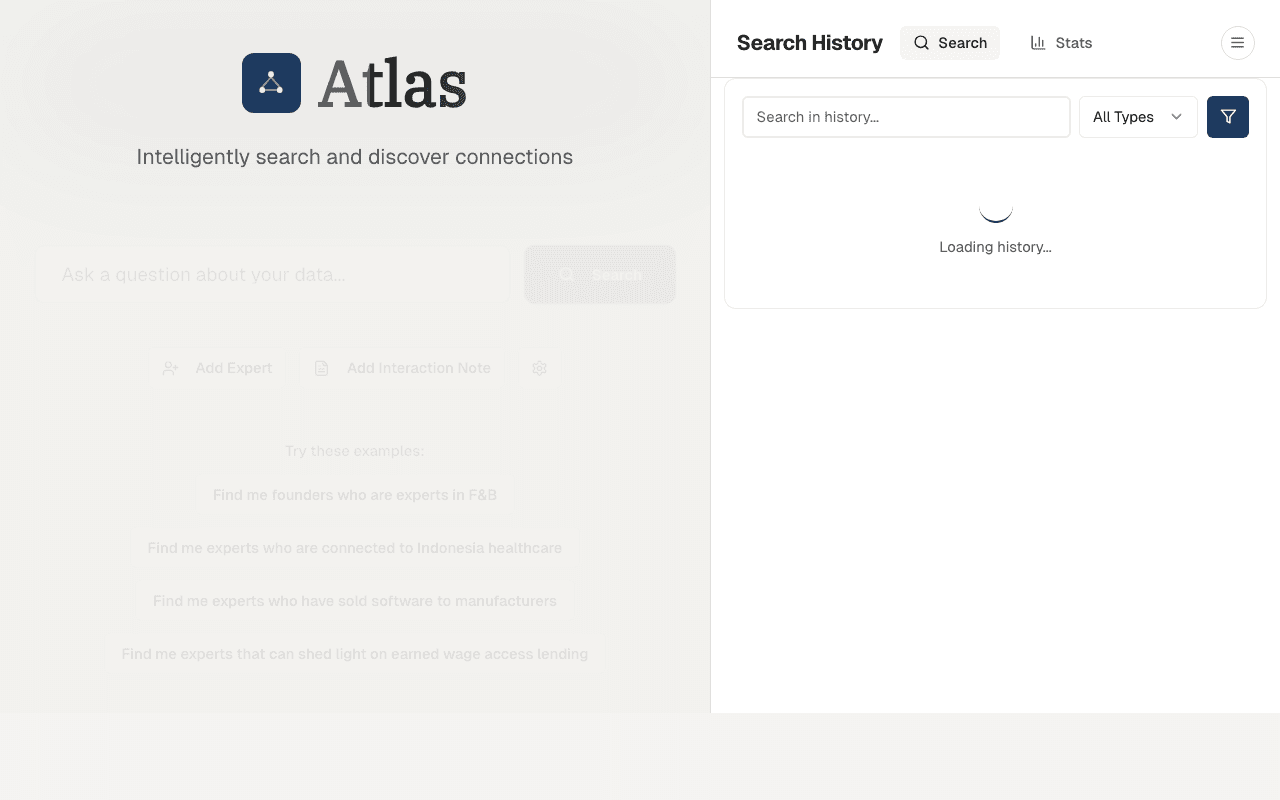 Atlas network search
Why I built this
VC relationship capital is locked in LinkedIn profiles, scattered email threads, and people's heads. When evaluating a deal, knowing who on the team has a warm connection to the founder, or to someone who does, can change the outcome. But surfacing that information meant asking around, checking LinkedIn manually, and hoping someone remembered. I wanted to make the team's collective network queryable.
What it does
Atlas models the founder and investor network as a graph, with edges weighted by interaction strength. A natural-language query layer sits on top: ask "who has a connection to this founder?" and it traverses the graph, finds the shortest warm path, and summarises the relationship context.
 Atlas architecture
Data pipeline
LinkedIn ingestion
LinkedIn profile data is batch-imported as structured JSON: work history, education, connections, shared groups. Each profile becomes a node; shared experiences (same company, same university, co-investors) become edges. The pipeline runs nightly against a watchlist of ~2,000 profiles, with incremental updates for new connections.
Data model
The graph is stored in Supabase PostgreSQL with two normalized tables built on top of the raw profiles data:
expert_companies: normalized fromprofiles.experiencesJSONB into an indexed relational table, enabling fast company-based lookups without scanning unstructured JSONexpert_connections: materialized relationship graph between experts, making multi-hop path queries feasible without repeated JOIN chains
Each edge in the connection graph carries:
- Weight: interaction strength (co-invested > same company > same university > shared connection)
- Recency: exponential decay based on last interaction date
- Context: free-text description of the relationship ("co-invested in Series A of Company X")
Indexes: IVFFlat for pgvector similarity search, B-tree on company/name columns for point lookups. An in-memory schema cache (1-hour TTL) eliminates 200-500ms of repeated DB introspection on every search.
Query pipeline
Natural-language queries run through a multi-step pipeline:
- Query classification: extracts
locationTermsalongside a semantic weight (0-50%) using gpt-4.1-nano or Groq llama-3.3-70b interchangeably via OpenRouter. SQL generation and classification run in parallel to cut latency. - Hybrid search: SQL filters with hard geographic constraints narrow the candidate set, then pgvector similarity search ranks by semantic relevance
- LLM reranker: a final LLM pass re-ranks hybrid results with geographic hard constraints applied, improving precision on location-qualified queries like "find fintech founders based in Singapore"
- Context synthesis: summarises the relationship path in natural language: "You to Sarah (co-invested in Fund II deal) to Mark (Stanford MBA '18) to Target Founder"
Network visualization
Expert profiles have a Connections tab showing known connections grouped by relationship type, alongside an interactive force-directed network graph (react-force-graph-2d). The graph renders live on click, which helps when tracing multi-hop paths before committing to an outreach sequence.
Technical decisions
- PostgreSQL over Neo4j: the graph fits in ~50K nodes. Recursive CTEs handle path queries well enough, and keeping everything in one database (Supabase) avoids the operational overhead of a dedicated graph DB.
- OpenRouter for model flexibility: query classification and reranking switch between gpt-4.1-nano (OpenAI) and llama-3.3-70b (Groq) depending on load and latency. OpenRouter's unified API makes this a config change, not a code change.
- Nightly batch over real-time sync: network relationships don't change by the hour. A nightly job keeps data fresh enough for deal-time lookups without the complexity of real-time event processing.
- Materialized connection table over runtime joins: computing the relationship graph at query time across thousands of profiles is too slow for interactive search. Pre-materializing the
expert_connectionstable trades storage for sub-100ms path lookups.
Stack
Next.js 15, React 19, Supabase (PostgreSQL + pgvector), OpenRouter (gpt-4.1-nano, Groq llama-3.3-70b), OpenAI (embeddings), react-force-graph-2d, Tailwind CSS, Vercel
Lead Engineer at ShiftControl, building an AI-native IT operations platform on Google Workspace. Previously the sole engineer at Iterative (early-stage VC fund, SEA & South Asia). Based in Ho Chi Minh City, Southeast Asia.